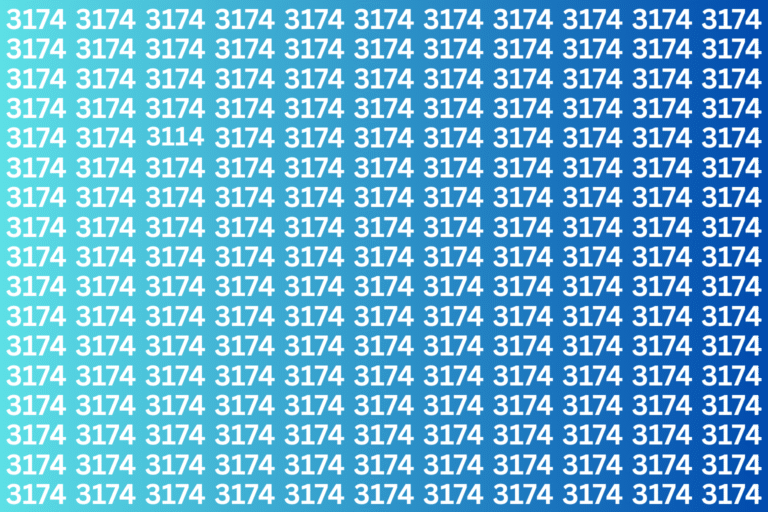



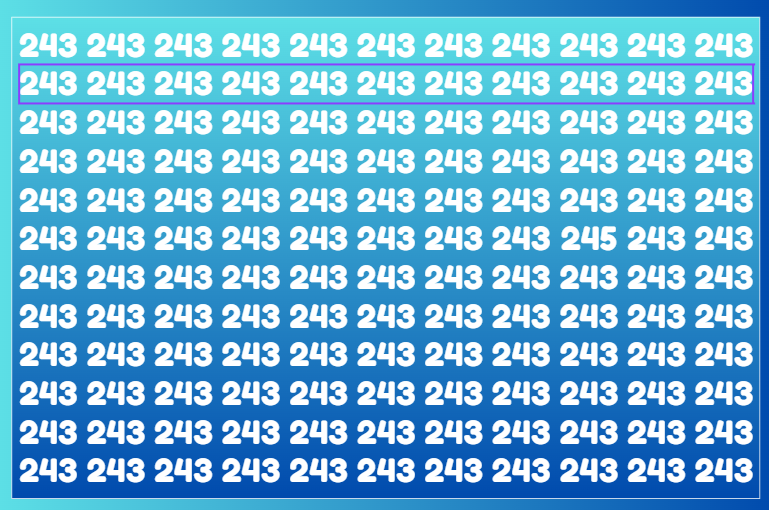
Do you think you have sharp vision and a razor-focused mind? Well, here’s your chance to prove it! A new viral puzzle is challenging internet users to test their observation skills: Can you spot the hidden number 245 in just 7 seconds?
At first glance, the image looks like a grid full of repeating numbers. Most of them are “243,” carefully arranged in neat rows. But somewhere in the middle, there’s a sneaky intruder—the number 245—blending perfectly with the crowd. The challenge is simple yet mind-boggling: find it before time runs out!
This test may sound easy, but the reality is that only people with eagle eyes and an extraordinary attention span can succeed quickly. Let’s explore why this puzzle is so tricky, the science behind optical illusions, and how challenges like these sharpen our brains.
Why This Puzzle Is So Addictive
Humans love challenges that tease the brain. From crosswords and Sudoku to hidden-object puzzles, our brains crave little bursts of problem-solving. This optical illusion takes advantage of exactly that.
The trick here lies in pattern repetition. When our eyes see the same number (243) repeated across the entire image, our brain gets used to the pattern and begins to “autopilot.” This makes it extremely difficult to notice the odd one out.
That’s why spotting 245 requires extra focus—your brain has to break free from the repetitive pattern and zoom in on subtle differences. And when you finally spot it, the sense of satisfaction is unbeatable!
The Science Behind Spotting Hidden Numbers
Why do optical illusions like this confuse us? The answer lies in how our brain processes information.
- Pattern Recognition
Our brains are wired to recognize patterns quickly—it’s a survival mechanism. But this also means that when too many similar elements are grouped together, the brain overlooks small differences. - Selective Attention
We often focus only on the “big picture,” filtering out details that don’t seem important. In this case, the repeated 243s dominate our vision, making the single 245 blend in. - Visual Fatigue
When staring at a repetitive pattern, our eyes get tired, and our focus decreases. This makes it harder to spot subtle changes.
That’s why optical illusions are not just fun—they reveal how the human brain works in fascinating ways.
Can You Spot the Hidden Number in 7 Seconds?
The real challenge here is speed. While anyone can eventually find the hidden number by scanning slowly, the test is about locating it in under 7 seconds.
People with sharper visual processing skills and strong attention to detail tend to succeed within the time limit. But even if it takes you longer, it doesn’t mean you’ve failed. In fact, by attempting such challenges regularly, you can train your brain to become faster and sharper.
Tips to Beat the Puzzle
If you want to improve your chances of finding the hidden number within seconds, here are a few strategies:
- Scan Methodically
Instead of letting your eyes wander randomly, scan the image row by row. This prevents you from skipping over the odd number. - Look for Irregular Shapes
Even though 245 and 243 look similar, the number “5” has a different curve that stands out if you focus carefully. - Change Your Viewing Distance
Try stepping back from the screen or zooming out. Sometimes, the change in perspective makes the odd number pop out. - Practice Regularly
The more optical illusions and brain puzzles you attempt, the better your eyes and brain get at spotting hidden details.
Why Optical Illusions Go Viral
Puzzles like this spread like wildfire across social media, and for good reason:
- They’re Fun and Competitive
People love challenging friends and family to see who spots it first. - They Boost Engagement
Social platforms thrive on shareable content, and optical illusions are perfect for sparking interaction. - They Offer a Quick Escape
In a world of busy schedules, a 7-second brain teaser is a fun break for the mind.
Benefits of Solving These Puzzles
You might think it’s “just a game,” but science says otherwise. Optical illusions and brain teasers provide surprising benefits, including:
- Improved Concentration: Training your eyes to focus on details makes you more attentive in daily life.
- Stronger Memory: Spotting subtle changes improves recall and strengthens short-term memory.
- Reduced Stress: Immersing yourself in a puzzle helps shift your mind away from stress and anxiety.
- Enhanced Problem-Solving Skills: Your brain gets better at analyzing data and noticing inconsistencies.
So, the next time you come across a puzzle like this, remember—it’s more than entertainment; it’s mental exercise.
Did You Find the Hidden 245?
If you found the number within 7 seconds, congratulations! You truly have eagle eyes. If it took you longer, don’t worry—practice makes perfect. The real value of this challenge lies in the journey of searching, not just the answer.
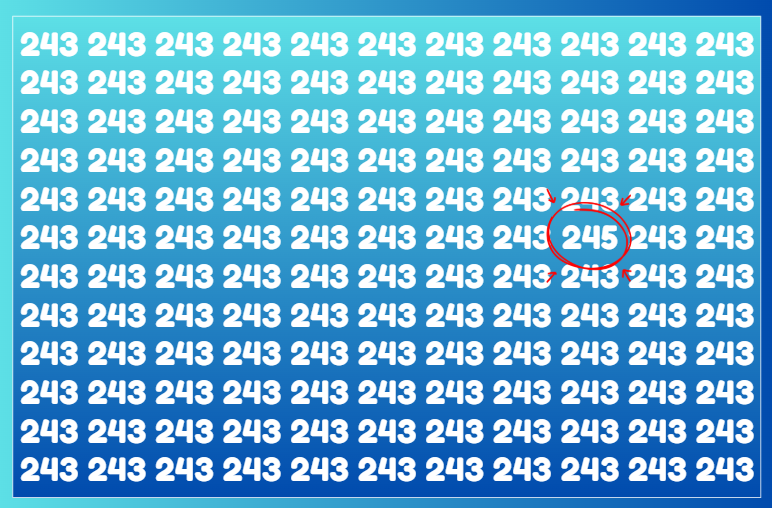
And here’s a secret: every time you try, your brain becomes a little sharper, your focus a little stronger, and your observation skills a little better.
FAQs
1. What is the 7-second optical illusion challenge?
It’s a brain teaser that asks you to spot the hidden number “245” among dozens of “243s” in under 7 seconds.
2. Why is it so hard to find the number 245?
Because the brain adapts to the repeating pattern of 243s and overlooks small differences, making the odd number blend in.
3. What happens if I can’t find it in 7 seconds?
Nothing at all! It’s just a fun challenge. Even if it takes longer, you’re still exercising your brain and improving your observation skills.
4. How can I improve my chances of finding it faster?
Scan row by row, look for unusual curves, change your viewing distance, and practice regularly with similar puzzles.
5. Do these puzzles actually improve brain function?
Yes. Studies show that solving visual puzzles improves concentration, memory, and attention to detail.
6. Why do people share optical illusions so much online?
Because they’re fun, competitive, and engaging. They spark curiosity and encourage social interaction.
7. Are there other puzzles like this?
Yes, many! From finding hidden animals in pictures to spotting differences in nearly identical images, there are countless variations of optical illusions to enjoy.