



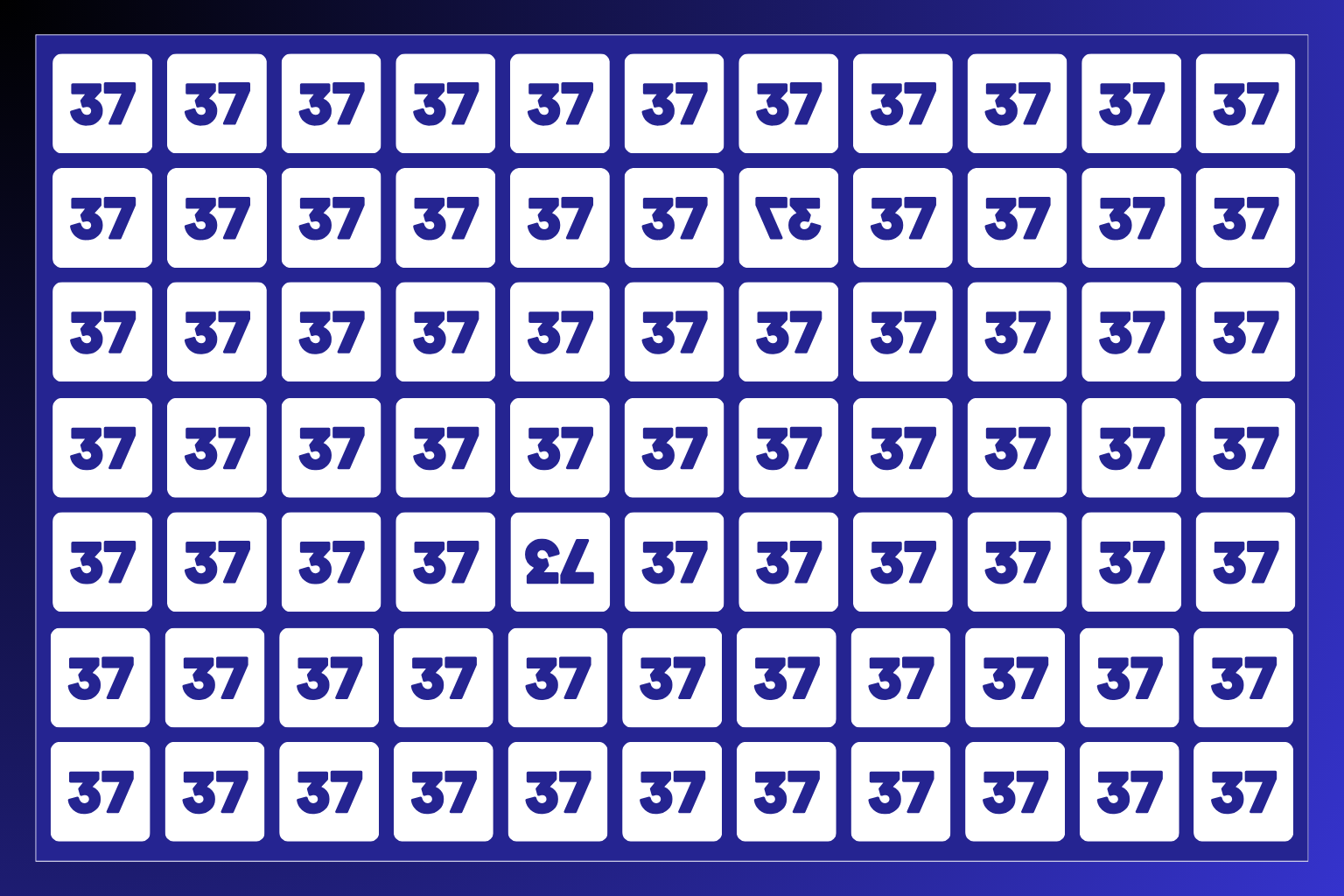
The human brain is one of the most powerful organs in the world, yet it is also surprisingly easy to trick. Optical illusions are proof of this fascinating contradiction. They challenge our ability to perceive reality, confuse our senses, and reveal just how much our brain depends on patterns rather than precise observation.
One of the latest illusions making waves online is the “Inverted 37 and 73 Challenge.” At first glance, it looks like a neatly arranged grid filled entirely with the number 37. But if you pay closer attention, you’ll discover two hidden imposters: an inverted 37 and a 73. The twist? You only have 6 seconds to find them.
This challenge is more than just a playful puzzle. It’s a test of perception, focus, and mental agility. Let’s explore why this illusion is captivating so many, what makes it so tricky, and how you can sharpen your skills to spot the odd one out.
Why Do Optical Illusions Fascinate Us?
From childhood to adulthood, humans have been fascinated by illusions. Whether it’s the classic “moving lines” images, impossible 3D shapes, or hidden-object puzzles, illusions have the power to entertain while educating us about the quirks of human perception.
Here’s why optical illusions like the 37 and 73 puzzle are so popular:
- They challenge the brain. Your mind loves solving problems, and illusions stimulate critical thinking.
- They test focus. In a world full of distractions, illusions force you to slow down and truly observe.
- They spark curiosity. People are naturally drawn to mysteries and hidden details.
- They are competitive. With a strict 6-second limit, this illusion turns into a game you want to win against friends and family.
The 37 and 73 Puzzle Explained
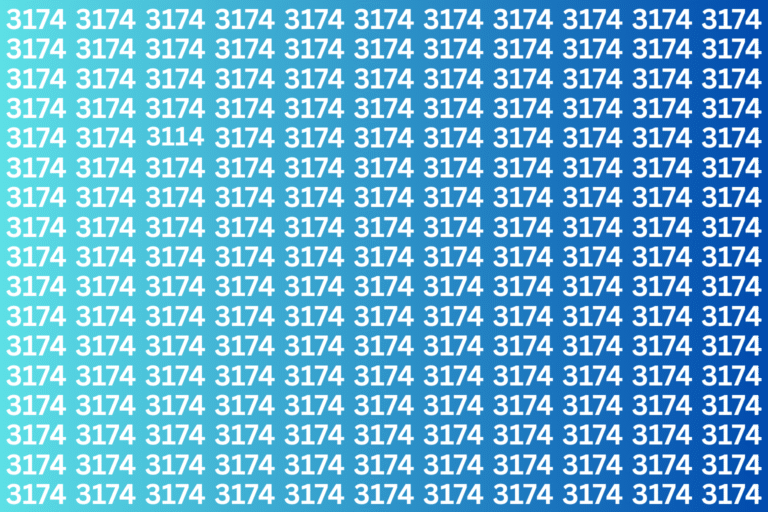
Take a look at the puzzle grid. At first, your brain processes the picture as a block of repeating 37s. That’s because humans are hardwired to recognize patterns quickly rather than focus on each individual element.
But hidden inside the sea of 37s, there are two tricksters:
- An inverted 37 (flipped upside down)
- A 73 (a similar-looking number with digits reversed)
Both are disguised so well that most people completely miss them—especially under the 6-second pressure.
The Science Behind Optical Illusions
Optical illusions reveal an important truth: seeing is not always believing.
When you look at an image, your eyes don’t just pass information to your brain—they filter it, organize it, and interpret it based on past experiences. In the case of the 37 puzzle, your brain expects every number to be a 37, so it automatically fills in the blanks.
This is why illusions are more than just games; they’re mini-experiments showing how the brain processes visual input.
The Fun of the 6-Second Rule
Why do puzzles like this often come with a strict time limit? Because time pressure tests your observation speed.
- With unlimited time, anyone could eventually find the 73 and the inverted 37.
- With just 6 seconds, however, the challenge becomes exciting, competitive, and mentally stimulating.
It’s the difference between jogging leisurely and sprinting in a race—you’re forced to focus intensely and act quickly.
Tips to Spot Hidden Numbers Faster
If you struggle with these challenges, here are some tips to sharpen your observation skills:
- Scan in Sections – Divide the grid into smaller chunks instead of scanning the whole image at once.
- Look for Differences in Shape – The inverted 37 and 73 will have slightly different angles. Train your eye to notice shape irregularities.
- Don’t Rush Too Much – While the timer is ticking, panicking reduces focus. Stay calm.
- Blink and Refocus – If your eyes get tired, a quick reset helps.
- Practice Often – The more puzzles you solve, the faster your brain becomes at spotting odd ones out.
Why the 37 and 73 Challenge Went Viral
Illusions often go viral because they are simple, competitive, and universal. You don’t need language skills, math knowledge, or cultural background to enjoy them.
The 37 and 73 illusion specifically gained popularity because:
- It looks deceptively simple.
- The time limit makes it fun and competitive.
- It’s easy to share online and challenge friends.
- People love proving they have sharp eyesight.
Try It Yourself!
Before you scroll further, test yourself with the image above. Start a timer for 6 seconds and try to find both imposters. If you manage to spot them within the time frame, you can proudly say you have eagle eyes.
✅ The Answer Revealed
If you couldn’t find them within 6 seconds—don’t worry, you’re not alone!
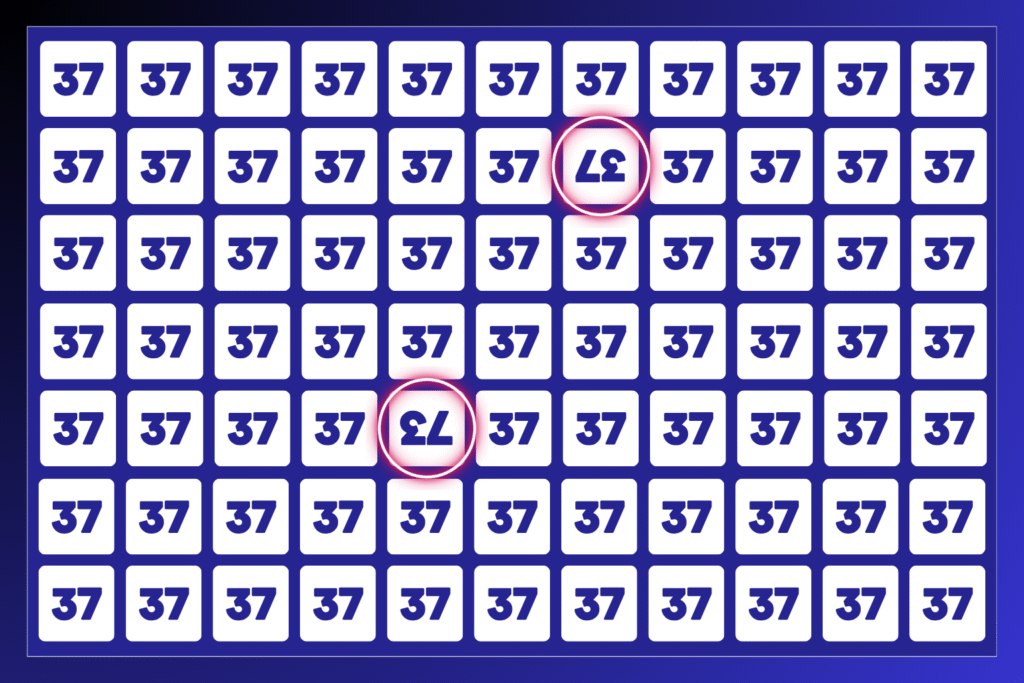
- The hidden 73 is located near the center of the grid.
- The inverted 37 is placed just above the 73, slightly offset, and looks flipped upside down.

These two sneaky imposters blend almost perfectly among the dozens of regular 37s, which is why they’re so easy to miss under time pressure.
So, if you spotted them both in under 6 seconds—congratulations! You truly have eagle eyes. 🎉
Final Thoughts
The Mind-Bending Optical Illusion Challenge featuring the hidden inverted 37 and 73 isn’t just another internet game—it’s a fascinating peek into how our brains process information. It shows that even the sharpest minds can be tricked by patterns and time pressure.
So, the next time you encounter such a puzzle, don’t just see it as a fun distraction. Consider it a mental workout that sharpens your observation skills, reduces stress, and boosts focus. And who knows—you might just become the fastest puzzle-solver among your friends!
FAQs About the 37 and 73 Illusion
Q1. What makes this illusion so hard?
Because your brain assumes every number is a “37,” it overlooks the inverted 37 and the 73 hidden within the grid.
Q2. Do I really have to finish in 6 seconds?
The 6-second limit is just for fun and competitiveness. With more time, most people can eventually spot the imposters.
Q3. Is this puzzle suitable for kids?
Yes! Kids often enjoy these puzzles, and they may even solve them faster than adults since they aren’t as conditioned by repetitive patterns.
Q4. Can solving illusions improve eyesight?
Not directly, but they do train your brain to process visual information more effectively, which improves observation skills.
Q5. What is the difference between an inverted 37 and a normal 37?
An inverted 37 is flipped upside down, making it look slightly different but still similar enough to trick the eye.
Q6. Why is a 73 included in the puzzle?
The 73 is there to add variety and increase difficulty—it forces you to look for both flipped and reversed numbers.
Q7. Can these puzzles actually boost intelligence?
They don’t raise IQ, but they definitely enhance mental agility, focus, and problem-solving skills.
Q8. How can I get better at spotting hidden objects?
Regular practice with optical illusions, puzzles, and memory games can significantly sharpen your observation skills.