



Optical illusions have fascinated humanity for centuries. They play tricks on our eyes, challenge our perception, and often spark heated debates about what we’re really seeing. Among the countless illusions that have gone viral online, one stands out for its sheer simplicity yet powerful effect: the Famous Vase vs. Faces Illusion.
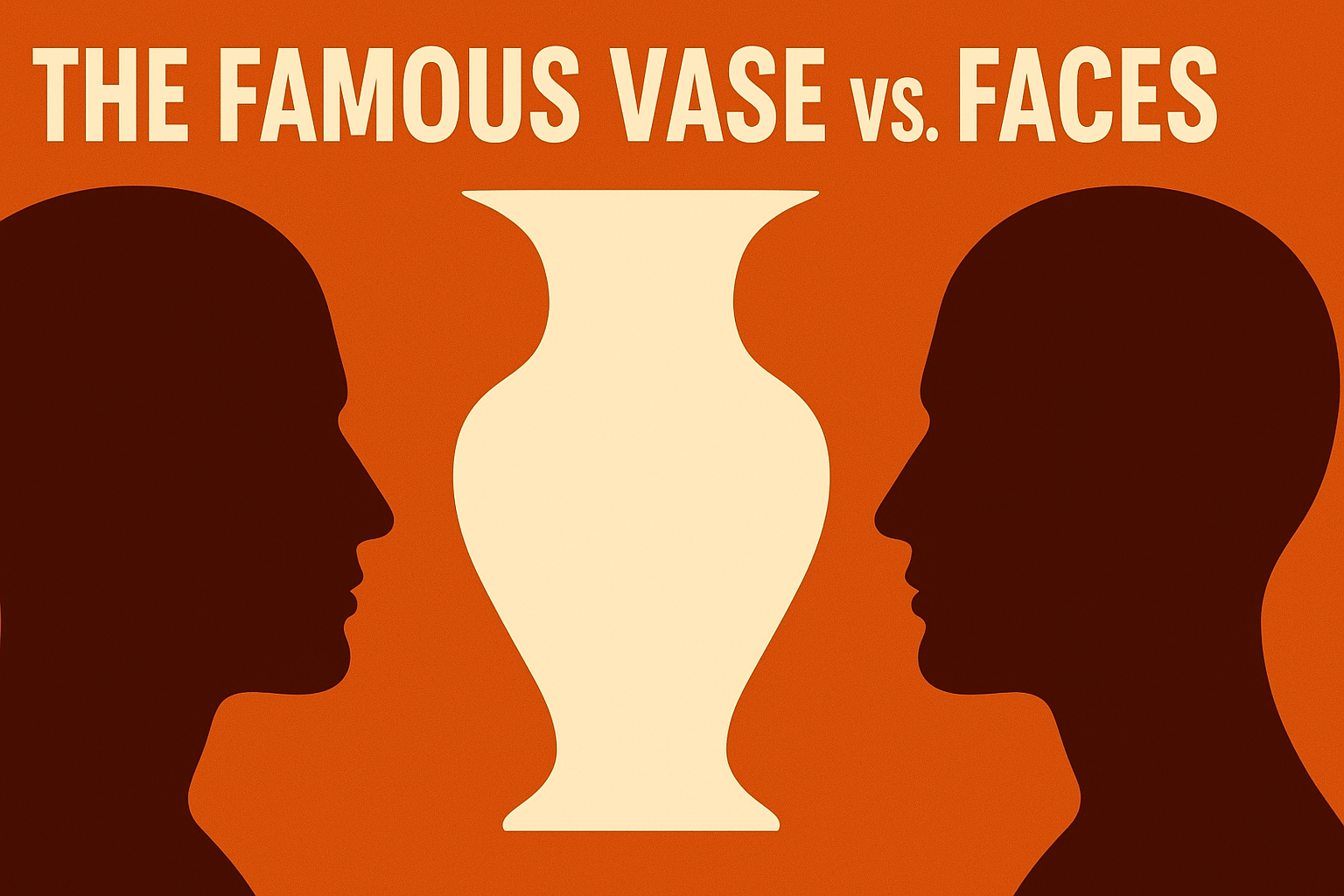
At first glance, the image looks straightforward. But depending on your perception, you might see either a vase in the center or two human faces staring at each other. Some people notice both almost immediately, while others strongly insist on seeing just one. This illusion has confused millions, sparking conversations across social media, classrooms, and even psychological studies.
But why does such a simple drawing manage to trick so many of us? And more interestingly, what does the part you see first say about your personality and how your brain works? Let’s dive deep into the fascinating world of the vase vs. faces illusion.
The Origin of the Vase vs. Faces Illusion
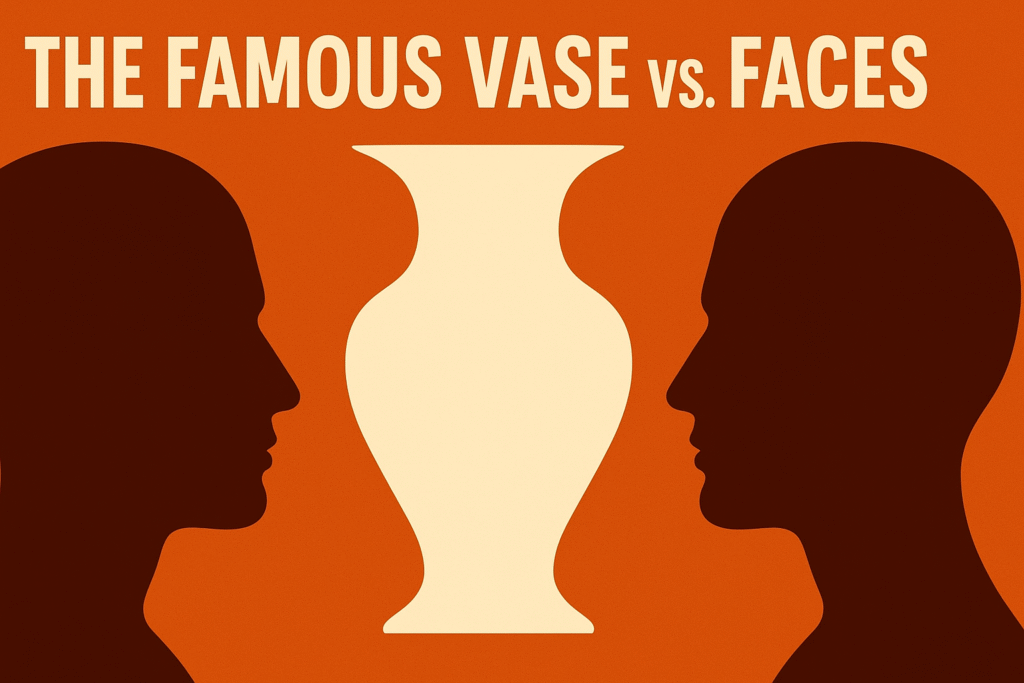
This illusion is widely known as the Rubin’s Vase, named after Danish psychologist Edgar Rubin who introduced it in the early 20th century. Rubin’s work focused on figure-ground perception, which refers to how our brain separates objects (figures) from their background (ground).
The beauty of this illusion lies in its ambiguity. Our brain can interpret the white central shape as a vase (the figure) while treating the black outlines as the background. Alternatively, it can reverse the interpretation, seeing the black shapes as two faces and the white space as the background.
This constant mental “flip” between vase and faces is what makes the illusion so captivating — and sometimes frustrating!
Why Do We See Different Things?
The answer lies in how each individual brain processes visual cues.
- Those who see the vase first are usually focusing on the positive space (the lighter, central area).
- Those who see the faces first are more tuned into the negative space (the darker, surrounding shapes).
Neither interpretation is wrong. In fact, this tug-of-war between figure and background perception is a natural phenomenon of human vision. Our eyes capture all the details, but our brain has to choose what to prioritize.
What It Reveals About Personality
Although the illusion itself is just a visual trick, psychologists and enthusiasts alike often suggest that what you notice first could reflect certain aspects of your personality. While not an official personality test, the interpretations are thought-provoking and, for many, surprisingly accurate.
If You Saw the Vase First 🏺
- Detail-Oriented Thinker
You focus on the object itself, which suggests that you have a sharp eye for detail and structure. - Goal-Focused
You tend to prioritize the “main thing” in life rather than getting lost in distractions. - Independent
Like the vase standing alone in the center, you value independence and personal space. - Practical
Your decisions are guided by logic and practicality more than abstract imagination.
If You Saw the Faces First 👥
- Relationship-Oriented
Your brain is naturally tuned to human elements, which means you value social connections deeply. - Empathetic
You can easily pick up on people’s emotions and often put others before yourself. - Creative and Intuitive
Seeing faces in shapes reflects your ability to think outside the box and spot patterns others miss. - Big-Picture Thinker
Instead of focusing on a single object, you notice interactions and relationships between elements.
If You Saw Both Instantly 🔄
- Adaptable and Flexible
You can switch perspectives easily, which makes you versatile in problem-solving. - Balanced Personality
You are both logical and empathetic, able to balance structure with creativity. - Open-Minded
You don’t lock yourself into a single interpretation; instead, you embrace multiple possibilities.
Why This Illusion Went Viral
The vase vs. faces illusion continues to trend online because:
- It’s Simple Yet Deep: Just two contrasting colors create an endless debate.
- It Feels Personal: People love analyzing what they saw first and linking it to personality.
- It’s Shareable: Friends and family often argue about what they see, making it perfect for social media.
In today’s world, where personality quizzes and brain challenges attract millions of clicks, this timeless illusion has found new life online, confusing and entertaining audiences all over again.
The Science Behind the Confusion
Our brains are not just passive receivers of information; they actively interpret it. The Gestalt principles of perception explain why illusions like this work. Gestalt psychology emphasizes that we often perceive whole structures rather than isolated parts.
- Figure-Ground Principle: We constantly decide what part of an image is the “figure” (object) and what is the “ground” (background).
- Reversibility: In Rubin’s vase, both interpretations are valid, so the brain flips between them.
- Focus and Context: Depending on what your mind prioritizes — objects or relationships — you’ll either see the vase or the faces.
This psychological tug-of-war is why two people can stare at the same picture yet see completely different things.
The Bigger Message
Beyond just being a fun illusion, the vase vs. faces debate carries a bigger life lesson: perspective shapes reality.
Two people can experience the same situation but interpret it differently depending on what they focus on. Some may zero in on details (the vase), while others notice relationships (the faces). Neither is wrong — both perspectives are valid, just like in real life.
Final Thoughts
The Famous Vase vs. Faces Illusion is more than just a visual trick — it’s a mirror into how our minds work. Whether you see the vase, the faces, or both, the illusion reminds us that perception is subjective.
- If you saw the vase, you’re likely detail-oriented, logical, and focused.
- If you saw the faces, you’re intuitive, empathetic, and relationship-driven.
- If you saw both, you have a balanced and adaptable personality.
It’s no wonder millions of people online keep debating this illusion. It’s simple, fun, and endlessly fascinating — a timeless reminder that sometimes, what we see depends less on our eyes and more on our mind.
FAQs
1. Why do some people see the vase while others see the faces?
It depends on how the brain processes figure-ground perception. Some people focus on the central white shape (vase), while others pay more attention to the dark outlines (faces).
2. Can what I see first really reveal my personality?
Not scientifically. However, what you notice first can reflect your tendencies — whether you prioritize detail, relationships, or balance.
3. Why does the image keep switching in my mind?
That’s the effect of perceptual reversibility. Your brain keeps alternating between two valid interpretations.
4. Can mood affect what I see?
Yes. If you’re calm and reflective, you might notice the vase. If you’re socially engaged or thinking about people, you may spot the faces first.
5. Is one interpretation better than the other?
No. Both perspectives are valid, and each highlights different strengths in personality and perception.